Types of Solar Panels: Monocrystalline vs Polycrystalline vs Thin-Film
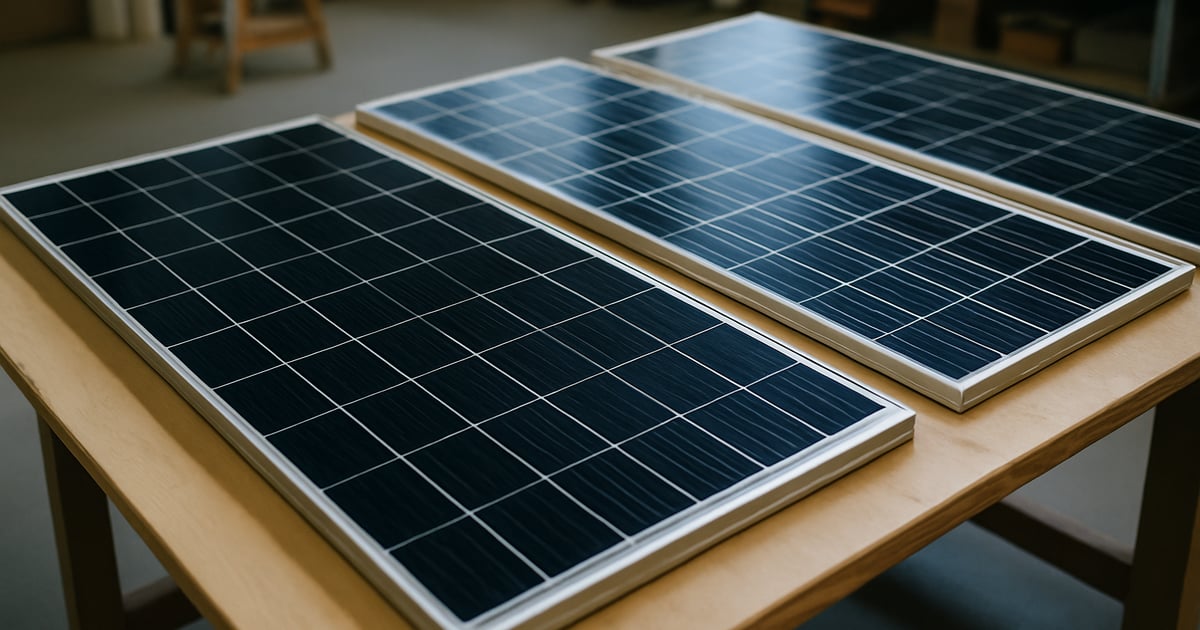
Not all solar panels are built the same way, and the differences affect efficiency, cost, and appearance. Here’s how the three main technologies compare.
Monocrystalline panels
Made from a single continuous silicon crystal structure, monocrystalline panels are the most common choice for residential solar today.
- Efficiency: Highest of the three types, commonly in the high-teens to low-20s percent range for standard consumer panels.
- Appearance: Typically a uniform black color, which many homeowners prefer aesthetically.
- Cost: Generally the most expensive per panel, though often a better value per usable roof square foot due to higher output.
- Best for: Homes with limited roof space where maximizing output per square foot matters most.
Polycrystalline panels
Made from multiple silicon crystal fragments melted together rather than a single crystal structure.
- Efficiency: Somewhat lower than monocrystalline, though the practical difference has narrowed with manufacturing improvements over the years.
- Appearance: Traditionally a distinctive blue, speckled look, though this varies by manufacturer.
- Cost: Generally less expensive than monocrystalline for comparable total wattage.
- Best for: Homes with ample unshaded roof space where price matters more than maximizing output density.
Thin-film panels
Made by depositing thin layers of photovoltaic material onto a substrate, rather than using rigid silicon wafers.
- Efficiency: Lowest of the three, often requiring significantly more surface area to produce the same output as crystalline panels.
- Appearance: More uniform and flexible, sometimes used in specialized or building-integrated applications.
- Cost: Lower material cost, but the larger area needed often offsets the savings for typical home installs.
- Best for: Large-scale installations with abundant space, or specialized applications like curved surfaces — rarely the practical choice for a standard home roof.
Side-by-side comparison
| Monocrystalline | Polycrystalline | Thin-Film | |
|---|---|---|---|
| Typical efficiency | Highest | Moderate | Lowest |
| Typical cost per watt | Highest | Moderate | Lowest (but needs more area) |
| Common residential use | Most common | Less common today | Rare |
| Appearance | Uniform black | Blue, speckled | Uniform, flexible |
How this affects your quote
Most residential installers today primarily quote monocrystalline panels, since the efficiency advantage generally pays for itself in usable roof space, especially on typical suburban roofs where space is a real constraint. If a quote includes polycrystalline panels, it’s not necessarily a red flag — it can be a reasonable cost-saving choice if you have plenty of roof space — but ask your installer to explain the reasoning specific to your roof.
What actually matters more than panel type for most buyers
- Warranty length and terms — see our guide on solar panel warranties.
- Manufacturer reputation and track record, since panels are expected to perform for 25+ years.
- How the panel choice interacts with your specific roof size and shading, covered in our roof suitability guide.
- Overall system design, including the inverter type paired with the panels.
Bottom line
For most homes, monocrystalline panels are the practical default given typical roof space constraints, and the efficiency difference between panel types matters less than overall system design, installer quality, and warranty terms. Don’t let panel type alone drive your decision — ask how the specific panel choice fits your roof and budget.
Frequently Asked Questions
- Which type of solar panel is most common for homes?
- Monocrystalline panels are the most common choice for residential installations today, largely because their higher efficiency lets installers fit more capacity onto a limited roof — a common constraint for homes compared to open commercial or utility-scale sites.
- Are more expensive panels always better?
- Not necessarily "better" in every case — a higher price typically reflects higher efficiency and sometimes a longer or more comprehensive warranty, which matters most when roof space is limited. If you have ample unshaded roof space, a lower-cost, lower-efficiency panel can sometimes deliver better overall value.
- Do thin-film panels make sense for a house?
- Rarely, for standard residential roofs. Thin-film panels are more common in large-scale or specialized applications where their lower efficiency is offset by lower material cost and flexibility, but for a typical home roof with limited space, the lower efficiency usually makes monocrystalline or polycrystalline panels the more practical choice.