String Inverters vs Microinverters: Which Is Better?
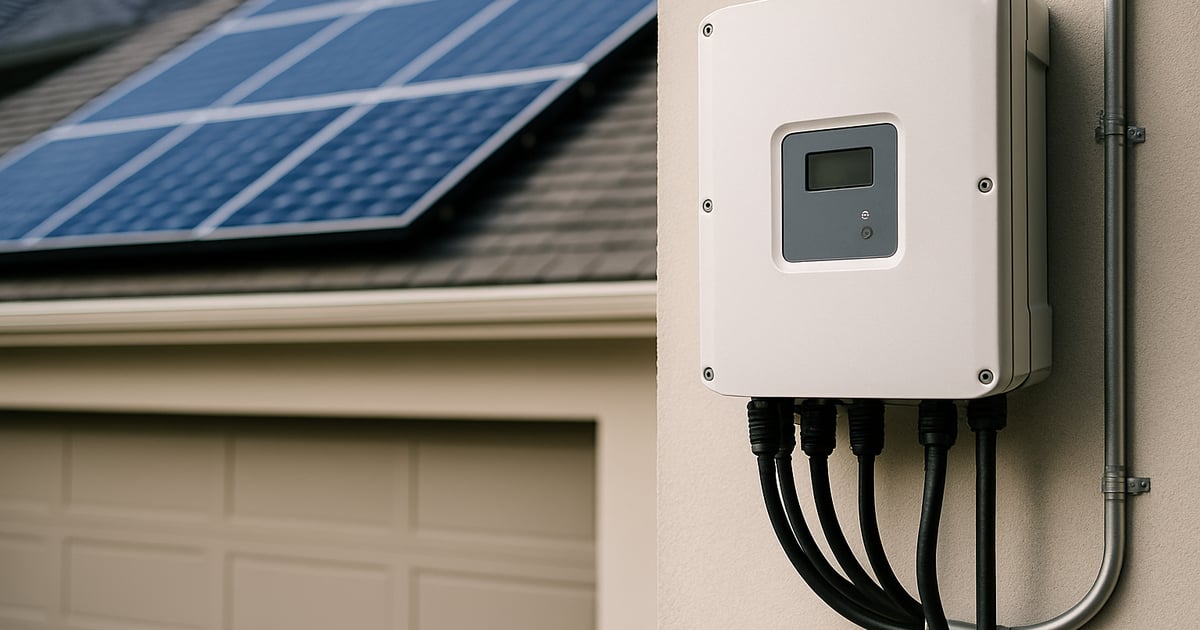
The inverter is the piece of equipment that converts your panels’ DC output into usable AC electricity — and the choice between a string inverter and microinverters affects both cost and how your system handles shading.
String inverters
A single inverter connects to a “string” of panels wired together in series, converting their combined DC output to AC in one central unit, typically mounted on an exterior wall or in a garage.
- Cost: Generally the lower-cost option for a straightforward, unshaded roof.
- Shading sensitivity: Because panels are wired in series, if one panel in the string is shaded, it can reduce the output of the entire string, not just that one panel — this is the main tradeoff.
- Monitoring: Typically reports total system output rather than individual panel performance, unless paired with add-on power optimizers.
- Best for: Simple roofs with a single orientation and little to no shading throughout the day.
Microinverters
A small inverter is attached to each individual panel, converting that panel’s DC output to AC right at the panel itself.
- Cost: Generally higher than a string inverter setup, since you need one unit per panel.
- Shading sensitivity: Each panel operates independently, so shading on one panel doesn’t drag down the output of the others — a meaningful advantage on roofs with partial shading or multiple orientations.
- Monitoring: Typically provides panel-level production data, making it easier to spot an underperforming panel.
- Best for: Roofs with partial shading, multiple roof planes or orientations, or homeowners who want detailed per-panel monitoring.
Power optimizers: a middle-ground option
Some systems use a string inverter architecture but add a power optimizer at each panel — a smaller device that conditions each panel’s output individually before sending it to a central string inverter. This captures some of the shading-mitigation and monitoring benefits of microinverters at a cost point closer to a traditional string inverter setup, and is worth asking your installer about if your roof has some shading but you’re trying to manage cost.
Which one fits your roof
- Simple, unshaded, single-orientation roof: A string inverter is often the most cost-effective, reasonable choice.
- Roof with some shading from trees, chimneys, or dormers: Microinverters or power optimizers typically deliver better real-world production for the added cost.
- Multiple roof planes facing different directions: Microinverters handle this naturally, since each panel performs independently regardless of which direction its section of roof faces.
- You want detailed panel-level monitoring: Microinverters are the more straightforward path to that level of visibility.
How this shows up in your quote
Ask your installer to specify which inverter architecture they’re proposing and why, given your roof’s specific shading situation — a good installer should be able to explain the reasoning in terms of your actual roof, not just a default configuration they use for every job. This ties directly into the broader roof suitability assessment that should happen before you finalize a system design.
Bottom line
There’s no universally “better” choice — it depends on your roof’s shading situation and how much you value granular monitoring versus minimizing upfront cost. A quote that defaults to microinverters on a completely unshaded, simple roof may be adding cost you don’t need; a quote that proposes a basic string inverter for a heavily shaded, multi-plane roof may be underselling how much shading will hurt your real-world production.
Frequently Asked Questions
- Do microinverters make my system more expensive?
- Generally, yes — microinverters typically add to the total system cost compared to a single string inverter, since you need one per panel rather than one unit for the whole array. Whether that added cost is worth it depends mainly on how much shading your roof has.
- Can I monitor individual panel performance with a string inverter?
- Not natively in the same way as microinverters, which report each panel's output individually. Some string inverter systems add power optimizers at each panel specifically to enable more granular monitoring and shading mitigation without going to full microinverters.
- Which option lasts longer, string inverters or microinverters?
- Warranty lengths vary by manufacturer and have shifted over the years for both technologies, so compare the specific warranty offered on your quote rather than assuming one category is inherently longer-lived — both are mature, widely used technologies at this point.