Solar Panel Costs and Savings in Florida (2026 Guide)
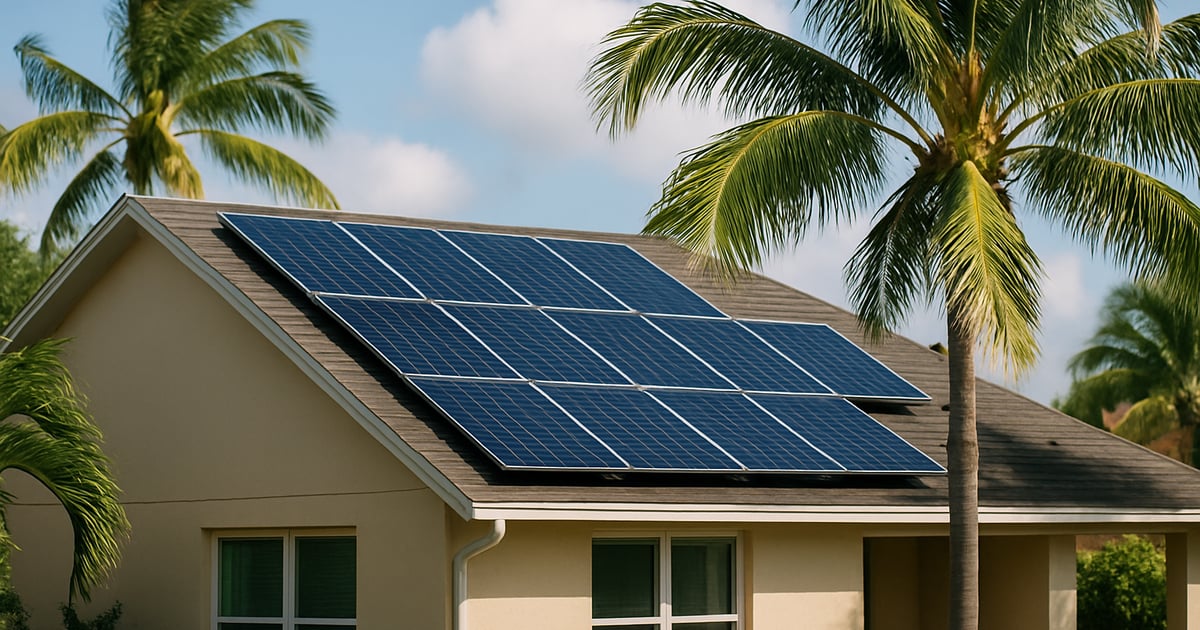
Florida is one of the few remaining states with both strong sun and full retail net metering — a combination that has vanished in most of the Sun Belt.
Florida solar at a glance (July 2026)
| Metric | Figure |
|---|---|
| Avg. residential electricity rate | 15.38¢/kWh (EIA, April 2026) |
| Avg. peak sun hours | ~5.3 per day (NREL-based estimate), consistent year-round |
| Typical installed cost | ~$2.40–$3.35 per watt before incentives (2026 national range) |
| Export compensation | Full retail net metering at FPL, Duke Energy Florida, TECO |
| Federal tax credit | None for purchases after Dec 31, 2025 (details) |
| State incentives | 6% sales tax exemption + 100% permanent property tax exemption |
Full retail net metering survived here
Florida’s investor-owned utilities — FPL, Duke Energy Florida, and TECO — must credit exported solar electricity at the full retail rate. Every kWh you export cancels a kWh you’d have bought at 15.38¢. Compare that with Arizona (~3¢ exports) or California (~3–8¢), and Florida’s position stands out: it kept the policy the rest of the Sun Belt rolled back.
It wasn’t inevitable — a 2022 bill to phase down net metering passed the legislature and was vetoed — but the current policy is secure through at least the next Public Service Commission review, and existing customers have historically been grandfathered when rules change. If net metering terms are a deciding factor for you, that’s an argument for locking in current terms rather than waiting. Background in our net metering guide.
Two clean tax exemptions, no paperwork drama
- Sales tax: solar equipment is exempt from Florida’s 6% state sales tax — roughly $1,000–$1,500 off a typical system at purchase.
- Property tax: 100% of the added home value is permanently exempt under Florida Statute 193.624 — your assessment simply doesn’t include the system.
Florida has no state income tax, so there’s no state credit; with the federal residential credit ended, these exemptions plus net metering are the whole incentive picture — and it’s still one of the better pictures in the country.
Hurricanes: mounting standards and the battery question
Two Florida-specific realities:
- Wind engineering. Florida’s building codes require hurricane-rated racking and attachment, engineered to your wind zone. Verify this explicitly when vetting installers — it’s a competence filter as much as a code requirement.
- Outage resilience. Grid-tied panels shut down during outages for line-worker safety. If multi-day post-storm outages are your concern, only a solar-plus-battery setup keeps the lights on — many Florida homeowners now treat the battery as storm insurance with a side of bill savings.
Consistent production, modest rates
Florida’s ~5.3 sun hours arrive unusually evenly across the year — no deep winter production trough like the Northeast. Retail rates are close to the national average, so payback is driven by system price and self-consumption. Run your own numbers with the calculator.
Bottom line
Florida in 2026 offers what most of the Sun Belt no longer does: full retail credit for every kWh you export, plus meaningful sales and property tax exemptions. The financial case is straightforward and the main state-specific work is picking a hurricane-competent installer — and deciding whether storm resilience justifies a battery.
Sources
Frequently Asked Questions
- Does Florida still have full retail net metering in 2026?
- Yes. Florida's investor-owned utilities — FPL, Duke Energy Florida, and TECO — are required to credit exported solar at the full retail rate, and the policy is secure through at least the next Public Service Commission review. A 2022 attempt to phase it down was vetoed, and no change is currently scheduled.
- What tax exemptions does Florida offer for solar?
- Two significant ones: solar equipment is exempt from Florida's 6% sales tax (roughly $1,000–$1,500 saved on a typical system), and 100% of the value the system adds to your home is permanently exempt from property tax under Florida Statute 193.624. Florida has no income tax, so there is no state tax credit — and the federal residential credit ended December 31, 2025.
- Should hurricane risk influence my solar decision in Florida?
- Yes, in two ways. Florida's building codes require hurricane-rated mounting, so verify your installer engineers to your wind zone. And extended post-storm outages are why many Florida homeowners add battery storage — panels alone shut off during a grid outage, but a solar-plus-battery system can keep essentials running.