Solar Panel Costs and Savings in Nevada (2026 Guide)
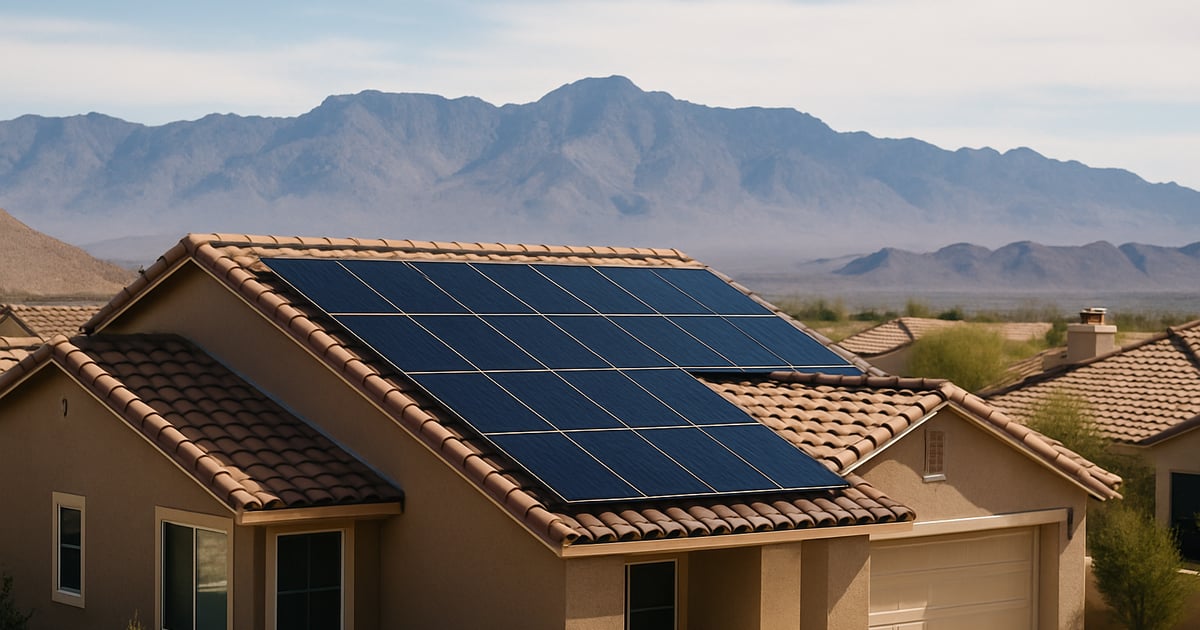
Nevada pairs near-Arizona sun with the most homeowner-friendly export policy in the desert Southwest: NV Energy credits exports at about three-quarters of the retail rate, locked for 20 years.
Nevada solar at a glance (July 2026)
| Metric | Figure |
|---|---|
| Avg. residential electricity rate | 14.29¢/kWh (EIA, April 2026) — lowest of our 15 states |
| Avg. peak sun hours | ~6.4 per day (NREL-based estimate) |
| Typical installed cost | ~$2.40–$3.35 per watt before incentives (2026 national range) |
| Export compensation | NV Energy net billing at ~75% of retail rate, locked 20 years |
| Federal tax credit | None for purchases after Dec 31, 2025 (details) |
| State tax credit | None (Nevada has no state income tax) |
The 75% export credit — and the 20-year lock
Nevada’s net metering law (AB 405) created a tiered structure: as installed solar capacity grew, the export credit stepped down through tiers. The current tier for new customers credits exports at approximately 75% of the retail rate. Compare that with roughly 20% of retail in Arizona’s net billing or California’s NEM 3.0, and Nevada’s policy looks genuinely favorable for the region.
Just as important: when you interconnect, your rate is guaranteed for 20 years at that location. That predictability removes one of the bigger unknowns in long-term solar payback — the risk that export policy changes underneath you, as it has in California and Illinois. See our net metering guide for the underlying mechanics.
No income tax, no tax credits — the math is production-driven
Nevada has no state income tax, so there’s no state credit, and the federal residential credit ended December 31, 2025. What Nevada does have is ~6.4 peak sun hours — second only to Arizona among our guides — and the lowest retail electricity rate of our 15 states at 14.29¢/kWh.
Those two facts pull in opposite directions: high production per installed watt shortens payback, but each offset kWh is worth less than in high-rate states. The result is a middle-of-the-pack but very predictable financial case, anchored by the 20-year rate lock. Run your usage through our calculator to see where you land.
Batteries: rebate suspended, check before you budget
NV Energy has offered storage rebates (up to roughly $3,000, tied to time-of-use participation), but the program has been suspended due to high demand. If a quote includes a battery rebate, verify the program is actually accepting applications. With a 75% export credit, batteries in Nevada are more about outage backup and time-of-use optimization than about rescuing export value — a different calculus than California’s. See solar-only vs solar-plus-battery.
Cooling loads and sizing
Like Arizona, Nevada’s summer cooling drives a large share of annual usage. Size for your real seasonal pattern rather than a flat monthly average — our sizing guide covers how.
Bottom line
Nevada’s case for solar is sun and stability: near-best-in-nation production, an export credit at ~75% of retail locked for two decades, and no tax-credit paperwork because there are no tax credits to claim. Payback is driven almost entirely by production and self-consumption, so an accurate production estimate matters more here than incentive-hunting.
Sources
Frequently Asked Questions
- How does net metering work with NV Energy in 2026?
- NV Energy credits exported solar electricity at approximately 75% of the retail rate under the current tier of Nevada's net metering law — the rate stepped down as earlier, higher tiers filled. Once you interconnect, your rate is locked for 20 years at that location, which gives Nevada one of the more predictable export policies in the West.
- Does Nevada have a state income tax credit for solar?
- No — Nevada has no state income tax at all, so there is no state credit to claim. With the federal residential credit ended as of December 31, 2025, Nevada homeowners' financial case rests on strong sun hours and NV Energy's 75%-of-retail export credit rather than tax incentives.
- Does NV Energy offer a battery rebate?
- NV Energy has offered battery storage rebates of up to roughly $3,000 tied to time-of-use plan participation, but the program has been suspended due to high demand. Check its current status directly with NV Energy before counting any battery rebate into your budget.